
The first stablecoin issuer Circle is quickly plummeting back to its opening price. What is the market worried about?

Original Author: Rubin, Top Influencer in the Knowledge Power List for Economics and Management
Editor's Note: This article is excerpted from a roundtable event on "Penetrating Stablecoins" jointly hosted by Zhihu and BlockBeats. The roundtable has accumulated over 26 million views since its launch, attracting widespread attention from both within and outside the industry. The event aims to present the latest developments, key mechanisms, and future trends of stablecoins to the public in a more intuitive and systematic manner.
Roundtable Link: https://www.zhihu.com/roundtable/stablecoin
The following is the original content:
Circle this quarter seems like a pig flying high on the high-interest rate trend, but the market is worried the wind direction may change:
Narrowing spreads, rising costs, single-profit business, regulatory uncertainty;
With these headwinds, companies flying high may also be prone to quick falls.
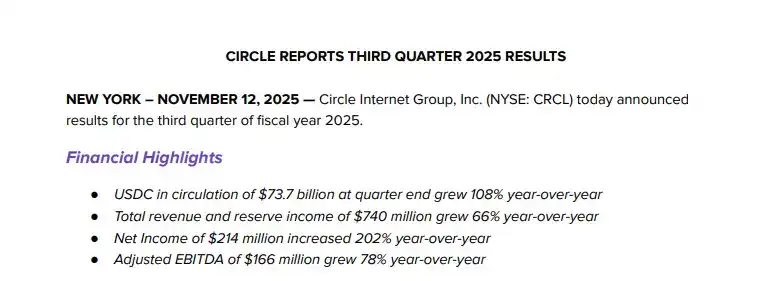
Imagine the stock market as a "marathon-style gamble," where yesterday player Circle rushed through a mid-race aid station (Q3) and achieved a good profit result. However, after investors reviewed the report, they believed that the upcoming slope, player pace, and aid may not be sustainable, leading to selling and causing a price drop.
1) Investors Focus More on the "Future"
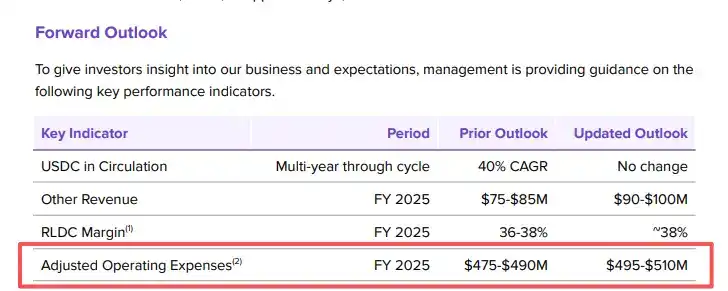
Although Circle significantly exceeded expectations in Q3, it also raised its full-year operating expense forecast ($495–510M). This implies that the company's future profit growth rate may be "eaten up," making it unable to achieve high profits again.
2) Reserve Yield Declining
Companies like Circle, which operate stablecoins, make a significant portion of their earnings through:
Issuing stablecoins, users buying stablecoins, and the company receiving dollars to purchase conservative asset investments such as government bonds/short-term notes
Take the spread without paying interest through this method.
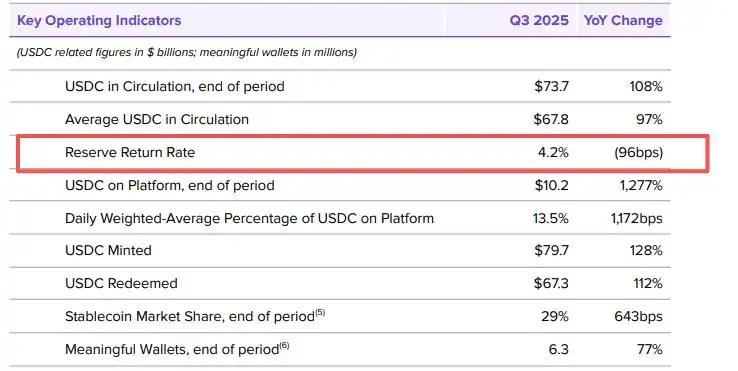
A report shows that although the total amount of reserve income is large, the reserve's simple interest return has decreased by approximately 96 bps.
If market interest rates decline or short-term yields compress, this profit-making method will significantly shrink in the future, directly impacting earnings.
3) Income Highly Relies on "Reserve Income"
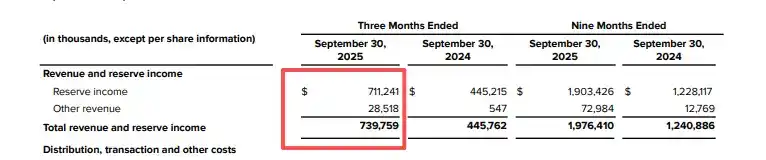
Out of Q3's $740M, the vast majority comes from reserve income ($711M), while "other income" (subscriptions, services, transactions, etc.) is only $29M.
This means that Circle's current business is more like a large treasury that doesn't need to pay interest to users, rather than a traditional SaaS or payment company;
When the market is concerned about narrowing spreads or regulatory impact, this single-income model will be discounted.
4) Regulatory and Policy Risks
Stablecoins are closely related to reserve assets, and any regulation (such as strict rules from the U.S. Congress/regulators on stablecoins) or on reserve assets (such as restrictions on holding government bonds/short-term notes) will affect revenue expectations.
During regulatory uncertainty, investors often demand a higher risk premium, leading to sell-offs and stock price declines.
In fact, Circle is currently in a delicate stage:
Its profit model is sound, its compliance foundation is solid, but the growth story is losing momentum.
Perhaps in the eyes of many traditional investors, it is more like a "dollar fund company," making safe but unimaginative money.
You may also like

On-chain finance: On-chain IPOs and on-chain ICOs, a new frontier in the trillion-dollar market

Rented Belief: How Much of the Bitcoin ETF Fund Flow is Real Money

The two giants are racing in "credit": loan balances of 9.9 billion vs 14.6 billion USD, Brazil has become the main battlefield

A company that was on the verge of bankruptcy has just surpassed Bitcoin in market value

B.AI partners with MiniMax to launch a limited-time free experience of M3, enabling zero-threshold implementation of Agentic productivity through full-stack infrastructure

The second half of the computing power battle: Intel CEO Pat Gelsinger reveals how AI is reshaping the global semiconductor supply chain

WEEX Live mode: Monitor 20 trading pairs at once and trade like a pro

Morning Report | Secret Network loses $4.67 million due to cross-chain vulnerability; Michael Saylor releases Bitcoin Tracker information again, may disclose increased holdings data next week

Kalshi's biggest competitor is not Polymarket
WEEX Makes Affiliate Access Easier on the Web and in the App
Customize Your Spot Trading Page: Drag Modules and Move the Order Panel Where You Want It

Perp DEX: The Next Generation Exchange "War"

10 Counterintuitive Insights on Latin American Payments

The AI gamble of mining companies: Valuations enter a phase of differentiation, and it's hard to turn the tide
A letter from Alliance to entrepreneurs: Written on the occasion of Cursor selling for 60 billion dollars
Stablecoins Finally Find Real Returns: On-Chain Reinsurance Re Explained | Interview with Re Founder Karan Saroya

The impossible triangle is simply a pseudo problem

Will MicroStrategy fall into a death spiral? What will the macro trend be in the second half of the year?
On-chain finance: On-chain IPOs and on-chain ICOs, a new frontier in the trillion-dollar market
Rented Belief: How Much of the Bitcoin ETF Fund Flow is Real Money
The two giants are racing in "credit": loan balances of 9.9 billion vs 14.6 billion USD, Brazil has become the main battlefield
A company that was on the verge of bankruptcy has just surpassed Bitcoin in market value
B.AI partners with MiniMax to launch a limited-time free experience of M3, enabling zero-threshold implementation of Agentic productivity through full-stack infrastructure
The second half of the computing power battle: Intel CEO Pat Gelsinger reveals how AI is reshaping the global semiconductor supply chain

Popular coins
Latest Crypto News


